
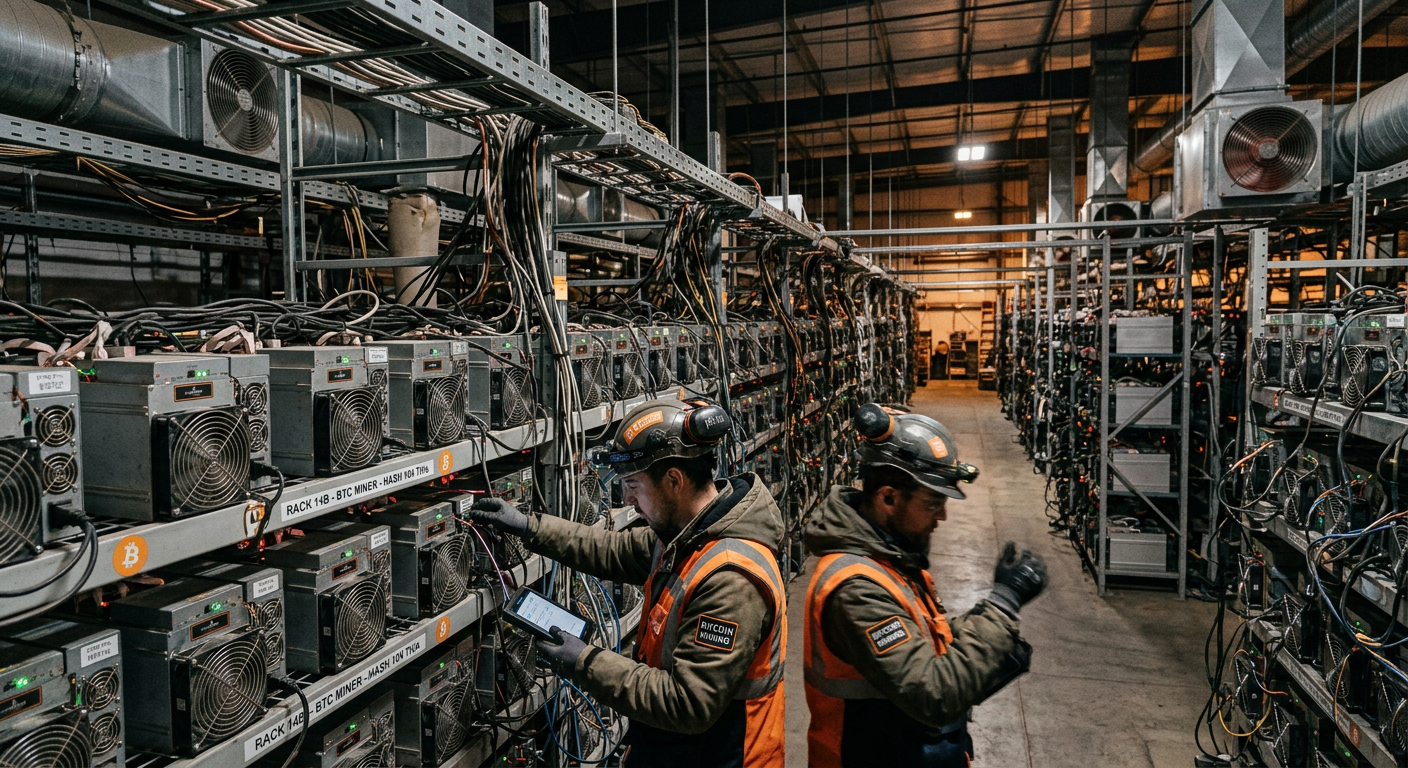
Bitcoin mining: what it is and how to start in 2026
Bitcoin mining is the process of confirming transactions and adding new blocks to the blockchain. Miners use ASIC hardware to solve cryptographic problems and receive a BTC reward for each block found. In 2026, after the halving, the reward is 3.125 BTC per block plus transaction fees (0.3-0.5 BTC). POOL BTC helps you choose a mining pool and calculate the real profitability.
In short: one ASIC Antminer S21 Pro (234 TH/s) at a rate of $0.06/kWh brings about 0.00018 BTC/day (~$17-19 at a rate of ~$100,000). After deducting electricity ($7-8/day), the net profit is $9-12/day. Check your option in the POOL BTC calculator.
How does Bitcoin mining work?
Bitcoin uses the SHA-256 algorithm. Every ~10 minutes, miners around the world compete for the right to add a new block. The winner is the one who is the first to find a hash that meets the complexity condition (the required number of leading zeros). The difficulty is automatically recalculated every 2016 blocks (~2 weeks) to keep the average block time at 10 minutes.
In May 2026, the Bitcoin network hashrate reached 745 EH/s. This means that all miners in the world perform 745 * 10^18 hash calculations per second. One ASIC S21 Pro (234 TH/s) provides 0.0000000314% of the total hashrate - this is exactly the share of the reward it receives in the pool.
What equipment is needed for mining?
In 2026, only ASIC miners are economically justified for Bitcoin. GPU mining of BTC is unprofitable due to many times higher consumption per TH/s.
| Model | Hashrate | Consumption | Efficiency |
|---|---|---|---|
| Antminer S21 XP | 270 TH/s | 3 645 W | 13.5 J/TH |
| Antminer S21 Pro | 234 TH/s | 3 510 W | 15.0 J/TH |
| WhatsMiner M66S | 298 TH/s | 5,066 W | 17.0 J/TH |
| Antminer S19k Pro | 120 TH/s | 2,760 W | 23.0 J/TH |
At a tariff of $0.06/kWh, the break-even threshold for electricity for the S21 Pro: with a hashprice below ~$0.058/TH/day, the device operates in the red. You can check the current hashprice and threshold in the calculator.
Which is more profitable: solo or pool?
With the hashrate of one or two ASICs, the pool is always more profitable. The probability of finding a block at 234 TH/s on your own is approximately once every 85,000 years. The pool unites thousands of devices and divides the reward in proportion to the hashrate. Payments come daily or when a minimum threshold is reached. More information about the FPPS and PPLNS payment schemes can be found in the article on choosing a pool.
How much does it cost to start Bitcoin mining?
Main expenses: equipment (S21 Pro $4,000-5,000 new), electricity ($7-10/day), infrastructure (UPS, coolers, racks). Payback period at current prices and tariff of $0.06: 14-18 months for S21 Pro. At a rate of $0.04 - 10-12 months. After the halving in 2028, the profitability will be halved if the rate does not increase.
Frequently asked questions about Bitcoin mining
Is it possible to mine Bitcoin at home?
It is possible if the electricity tariff does not exceed $0.07-0.08/kWh and the room can withstand noise (70-80 dB) and heat generation (one S21 Pro - 3.5 kW heat). In practice, industrial hosting at a tariff of $0.04-0.06 gives the best ROI.
When will ASIC pay off?
At the current hashprice (~$0.10/TH/day) and the cost of S21 Pro $4,500 - about 15-16 months at a tariff of $0.06/kWh. The period significantly depends on the BTC rate and the complexity of the network - use calculator to calculate with your data.
Which pool should a beginner choose?
For starters, a large pool with an FPPS scheme: Antpool, F2Pool, ViaBTC. FPPS pays for each share, regardless of whether the pool has found a block. This reduces income dispersion to a minimum. Compare the current conditions at POOL BTC.
What is hashprice?
Hashprice is income per 1 TH/s of hashrate per day, expressed in USD or BTC. In May 2026: $0.09-0.11/TH/day. This is a key indicator of profitability: hashprice * your_hashrate - cost_of_electricity = your_profit.
Bottom line: is it worth starting Bitcoin mining in 2026?
Bitcoin mining in 2026 remains profitable for those who have access to electricity cheaper than $0.07/kWh and modern equipment (14-17 J/TH). At a tariff of $0.04-0.06, the payback period for S21 Pro is 12-18 months - this is a reasonable investment with a horizon of 3-5 years. If the tariff is above $0.09 and using old ASICs (S19 series), entry is not advisable until the next rate increase or difficulty decrease. Key steps: choose the right pool (POOL BTC), calculate the real profitability taking into account your tariff, upgrade your equipment before the 2028 halving.