
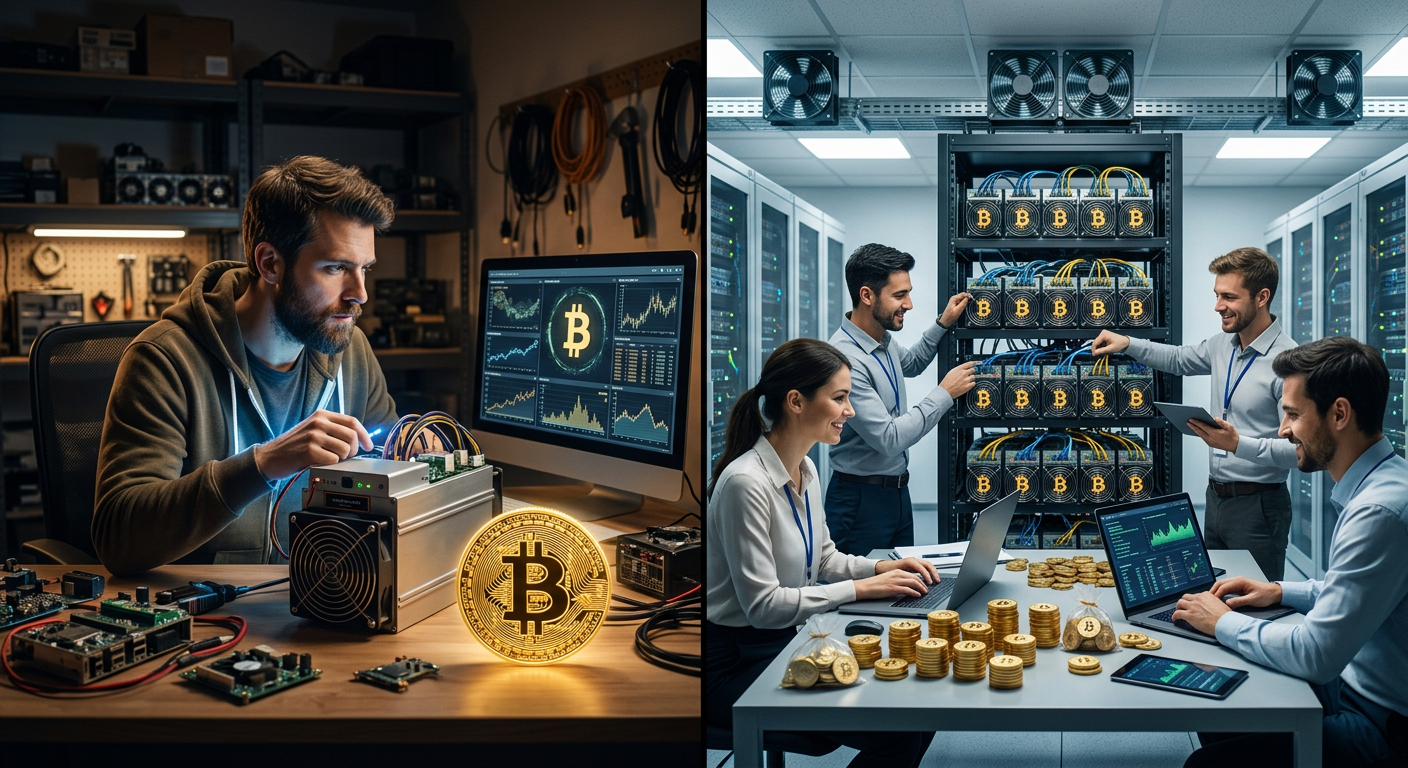
Solo mining versus pool: when it makes sense to mine alone
In a pool you consistently receive small payouts in proportion to your hashrate. In solo, you look for a block yourself: the reward is large (3.125 BTC + ~0.3-0.5 BTC commissions), but it comes rarely and unpredictably. At level 1 PH/s, the probability of finding a block per day is about 0.13%. That is, on average, once every ~2 years. POOL BTC publishes the conditions of the largest pools: commissions, minimum payouts and uptime.
In short: mathematically, the average income in solo and pool is the same with the same hashrate. The difference is in the variance. Solo is justified only with a hashrate of 5-10 PH/s and a horizon of 5+ years. For everyone else - a pool.
What is the difference between solo and pool mining?
In a pool, thousands of miners share a hashrate. When the pool finds a block, the reward is divided in proportion to each miner's contribution (minus the commission). Payments come every few hours in small amounts.
In solo you work as a separate node. The connection goes to your own Bitcoin node (or through a solo pool like ckpool.org). You get the entire block (~3.5 BTC in 2026), but only when you find it yourself.
At what hashrate does solo mining become reasonable?
Approximate calculation: with a network hashrate of 745 EH/s and a block every 10 minutes, the expected time until a block is found in solo:
| Your hashrate | Expected time to block |
|---|---|
| 1 PH/s (~5 ASIC S21 Pro) | ~1,400 years |
| 10 PH/s (~47 ASIC) | ~140 years |
| 100 PH/s (~472 ASIC) | ~14 years |
| 1,000 PH/s (1 EH/s) | ~1.4 years |
The only scenario where solo makes sense today are large farms from 1-2 EH/s or miners who are consciously ready for variance as a “lottery”.
What is “luck” and why does mathematics not guarantee a result?
Each hash is an independent random experiment. The probability of finding a block with hashrate X does not accumulate: if you have already been “waiting” for 2 years, the probability of finding a block tomorrow is no higher than on the first day. This is a property of geometric distribution. Pools eliminate this risk by turning infrequent large payouts into stable cash flow. Compare the real conditions of the pools at POOL BTC.
What payout schemes do solo pools offer?
Some pools offer "solo" as a separate mode: you work in the pool, but when you find "your" block, you receive the full reward minus a small commission (usually 2%). This lowers the technical barrier to entry into solo without the need to run your own full Bitcoin node. Read more about payment schemes in FPPS vs PPLNS.
Frequently asked questions about solo mining
Is it possible to mine solo with one home ASIC?
Technically, yes, through a solo pool. But with a hashrate of 100-200 TH/s, the expected time to a block is thousands of years. This is a purely lottery scenario, not an investment.
Do you need a full Bitcoin node for solo mining?
Yes, if you connect directly through getblocktemplate. Or use solo pools (ckpool.org, solo.ckpool.org) - they provide block templates from their nodes and take a 2% commission only when a block is found.
Are there tax advantages to solo mining?
In most jurisdictions there is no difference: both pool payouts and solo block are taxed as mining income at the time of receipt. Check with your tax advisor.
How to assess whether it is worth switching to solo from the pool?
Only if your total hashrate exceeds 0.5-1 EH/s and you are ready for irregular payments. In other cases, a pool with FPPS will give a more predictable result. POOL BTC rating helps you select a pool.
How to technically connect to a solo pool?
Solo mining does not mean that you need to deploy a full Bitcoin node yourself. There are specialized solo pools that provide stratum endpoint and block templates from their node. You simply configure the ASIC to their address:
| Solo-pool | Stratum address | Commission on success |
|---|---|---|
| ckpool.org (solo.ckpool.org) | stratum+tcp://solo.ckpool.org:3333 | 2% |
| solo.antpool.com | stratum+tcp://solo.antpo ol.com:3333 | 1% |
| solo.f2pool.com | stratum+tcp://solo.f2pool.com:3333 | 2% |
Settings takes 5 minutes: in the ASIC interface (Antminer/WhatsMiner) replace the pool address in Pool 1. No KYC is required - only your Bitcoin address in the Worker field. When a block is found, the payout goes directly to your address minus 2%. On average, ckpool.org helps to find 1-2 blocks per week - for participants with a total pool hashrate (usually 1-3 EH/s). For a specific miner with 1 TH/s, the math does not change: the probability is still ~1 block in hundreds of thousands of years. But some miners consciously take this risk - like a “bitcoin lottery”. You can calculate the realistic profitability of pool mining in the POOL BTC calculator.
Result: solo mining in 2026 - for whom does it make sense
Solo mining in 2026 is a conscious choice, not an accident. For farms with a hashrate below 1 EH/s, this is a mathematically losing strategy over the life of the equipment. But for large players and miners who are ready for variance as a tool, solo through ckpool.org gives a full block without splitting. For everyone else, a pool with FPPS and a low payout threshold will provide predictable income. Compare the real conditions on POOL BTC and calculate your profitability.