
Bitcoin mining trends in 2026: halving, new ASICs and regulation
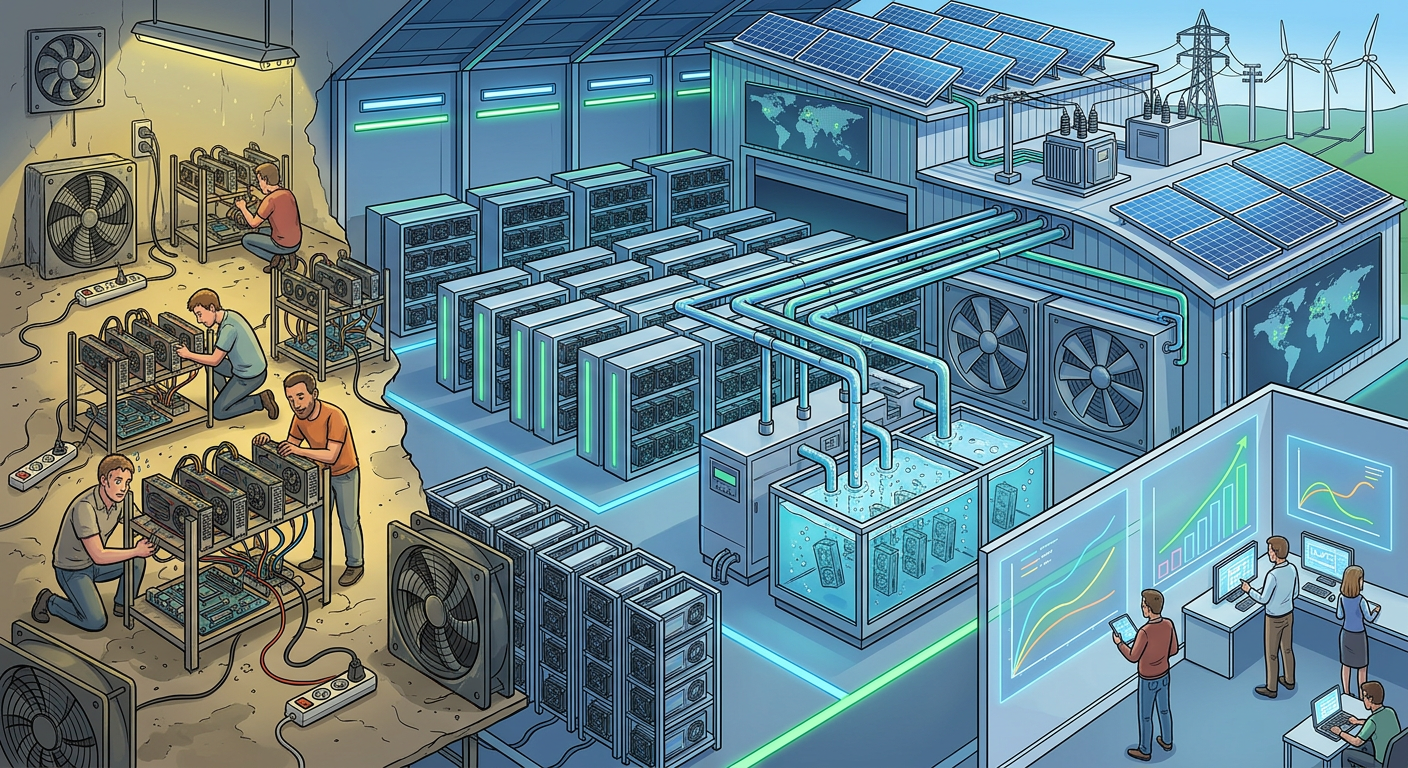
The year 2026 in Bitcoin mining is determined by three factors: the consequences of the April 2024 halving (reward 3.125 BTC), a wave of new ASICs of the S21/M60/M66 generation and the growing share of commissions in block income. Network hashrate in May 2026 - ~745 EH/s, hashprice ~$46/PH/day. POOL BTC tracks how these trends affect fees and pool conditions.
In brief: efficient ASICs (16-17 J/TH) and cheap electricity ($0.04-0.06/kWh) are the main conditions for profitable mining in 2026. Regulation is becoming stricter in the EU and several Asian countries, but The USA, Kazakhstan and the UAE are still attracting new capacity.
What did the 2024 halving change for miners?
The April 2024 halving reduced the block subsidy from 6.25 to 3.125 BTC. Consequences:
- Miners with a tariff above $0.07/kWh went into the red and sold ASIC
- The hash rate for 2 months after the halving decreased by ~8%, then continued to grow
- The share of commissions in the block revenue increased to 10-15% during periods when the mempool was busy
- BTC rate by May 2026 increased to ~$95,000, which partially compensated for the decrease in BTC income
Which ASIC miners are leading in efficiency in 2026?
| Model | Hashrate | Energy efficiency | Estimated price |
|---|---|---|---|
| Antminer S21 Pro | 212 TH/s | 16.1 J/TH | ~$4,500 |
| WhatsMiner M60S | 212 TH/s | 18.5 J/TH | ~$4 200 |
| WhatsMiner M66S | 298 TH/s | 16.0 J/TH | ~$6,000 |
| Antminer S21 XP | 270 TH/s | 14.2 J/TH | ~$7,000 |
A detailed comparative review of flagship ASICs is in the article Antminer S21 Pro vs WhatsMiner M60S.
How does regulation affect mining in different countries?
The picture in 2026 is heterogeneous:
- USA: legal, FASB requires accounting for crypto assets at fair value; several states (Texas, Montana) provide preferential tariffs.
- EU:MiCA does not prohibit mining, but requires disclosure of energy consumption and CO₂ emissions.
- China:Mining is still prohibited as of 2021, but capacity has moved from China to Kazakhstan and the USA.
- Russia:Mining is legal upon registration Individual entrepreneur/LLC, with mandatory declaration of income.
- Kazakhstan: licensing from 2023, environmental fee.
How does the share of commissions in miners’ income grow?
After halving, the subsidy is 3.125 BTC/block. With an average commission of 0.3-0.5 BTC/block (periods when the mempool is busy give up to 3-5 BTC/block), the share of commissions in total income increased from 2-3% to 10-15%. To select a pool, it is important whether the payout scheme takes into account commissions: FPPS includes them automatically, PPLNS only when the pool finds a block. Read more: FPPS vs PPLNS.
Frequently asked questions about mining trends
Should you buy ASIC now or wait for the next halving?
The next halving is scheduled for April 2028. Buying 12-18 months before it historically gives the best ROI: BTC price usually is growing in anticipation of the event, and the hashrate has not yet reached its peak. But this is not a guarantee.
Will mining go completely to AI/HPC?
Large public companies are indeed redirecting some of their capacity (up to 26% by 2026 estimates), but SHA-256 mining continues to grow. Read more: The transition of miners to AI/HPC.
Which ASICs will become obsolete in 2026?
Device with efficiency above 30 J/TH (S19, M30, 2020 series) at a tariff of $0.06/kWh operate at zero or minus and are gradually being phased out operation.
How to prepare the farm for the next halving in 2028?
The next Bitcoin halving is expected in April-May 2028 (block 1,050,000). After it, the reward will decrease from 3.125 to 1.5625 BTC. Historically, the rate compensated for the decline: before the 2024 halving, the rate increased from $25,000 to $70,000, and after - to $100,000+. But there are no guarantees. Practical steps for preparation:
| Step | Horizon | Goal |
|---|---|---|
| Upgrade ASIC to top efficiency (14-17 J/TH) | 2027 | Reduce break-even threshold |
| Fix tariff <$0.05 long-term contract | 2027 | Margin at any hashprice |
| Accumulate BTC reserve (3-6 months of expenses) | 2026-2027 | Survive the drawdown after halving |
| Diversify: part of the hashrate into a hedge against downtime | Now | Reduce the risk of downtime |
Miners who were not prepared for the 2024 halving were forced to sell BTC at local minimums. Those who lowered tariffs and upgraded equipment went through the period of declining profitability painlessly. Current calculations of profitability with a forecast until 2028: POOL BTC calculator.
Result: trends in 2026 and position for miners
Bitcoin mining in 2026 is entering a new phase: after the halving, only farms with a tariff below $0.06 and equipment newer than S21 survived. Regulation is becoming systemic - this is a long-term positive for the industry (stability of rules) and a short-term burden (compliance costs). The next halving in 2028 will again cut off the least efficient ones. Strategy for 2026-2028: buy the best ASIC, fix the tariff, accumulate BTC in reserve. The current calculation of profitability with your parameters is at POOL BTC.