
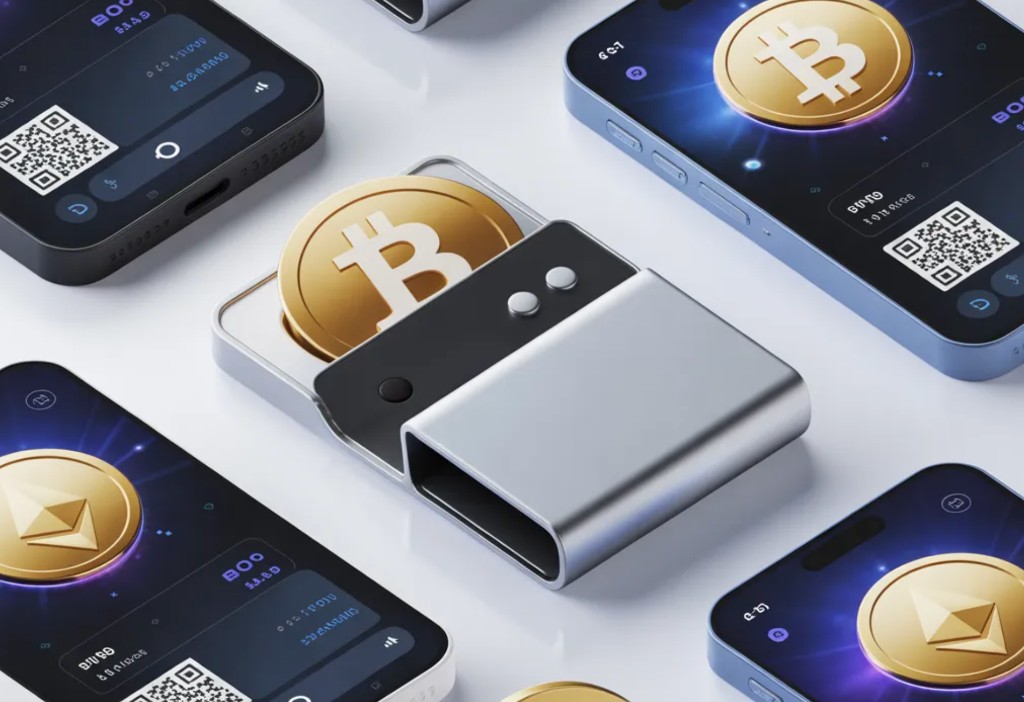
Crypto wallets: types, how to choose and where to store Bitcoin in 2026
A crypto wallet is a tool for accessing your funds on the blockchain. He does not store the coins themselves, but a private key, which confirms the right to dispose of them. Losing a key or seed means permanent loss of access to assets. In 2026, the main choice is: store on an exchange (convenient, risky) or in your own wallet (safer, requires responsibility).
In short:for amounts over $1,000 - a hardware wallet (Ledger, Trezor). For daily spending - a mobile wallet (Muun, BlueWallet). For mining payments - first to your wallet, then, if necessary, to the exchange. Never store your seed phrase in the cloud or instant messengers.
What types of crypto wallets exist?
| Type | Examples | Security | Convenience |
|---|---|---|---|
| Hardware (cold) | Ledger Nano X, Trezor Model T | Maximum | Low |
| Mobile (hot) | Muun, BlueWallet, Trust Wallet | Medium | High |
| Desktop | Electrum, Sparrow | Average | Average |
| Exchange custodial | Binance, Bybit | Low (exchange risk) | Maximum |
| Paper | Generated key pair | High (subject to compliance) | Minimum |
What is a seed phrase and why should you not lose it?
Seed phrase (mnemonic phrase) - 12 or 24 words, from which all your private keys are restored. This is the only way to restore access if you lose your device. Rules for storing a seed phrase:
- Write it down on paper, store it in several physically different places
- Never take photographs, do not enter on online sites
- Do not inform anyone - neither technical support nor “representatives” of the wallet
- Consider metal engraving for protection from fire and water
How to choose a wallet for storing mining payments?
Recommended scheme for a miner:
- Operational balance (payments from the pool) - a mobile wallet like BlueWallet or Muun. Daily payments come here.
- Long-term storage - hardware wallet (Ledger/Trezor). Transfer here when you have accumulated at least 0.01 BTC.
- Trading and withdrawal - exchange account (Binance, Bybit). Keep here only the amount you plan to sell.
Set up a payout address from the pool directly to your non-custodial wallet - it’s safer than keeping it on the pool. Select a pool with payment address settings: POOL BTC.
Hardware wallet or exchange: what is the difference?
The main difference: a hardware wallet is “not your keys, not your coins” in your favor. On an exchange, your coins are technically owned by the exchange. Examples of losses:
- FTX (2022): ~$8 billion of users frozen and partially lost
- Mt. Gox (2014): ~$450 million stolen from exchange clients
- Bitfinex (2016): ~$72 million stolen (later partially returned)
The Ledger Nano X hardware wallet costs ~$130 and protects against all these risks if the seed phrase is stored correctly.
Frequently asked questions about crypto wallets
Which is better - Ledger or Trezor?
Both are reliable. Trezor is completely open source, Ledger is partially closed but has a Secure Element chip. When the data of Ledger users was leaked in 2020, the funds of the victims remained safe - the physical keys were not compromised.
Is it possible to store Bitcoin on a phone?
It is possible if the amount is small (up to $500-1000). Mobile wallets are vulnerable to device hacking, malicious apps, and physical theft. For large amounts - only a hardware wallet.
How to transfer Bitcoin from an exchange to a wallet?
On the exchange: Wallet - Withdrawal - Bitcoin - indicate the address of your wallet - confirm the withdrawal. Network commission is usually 0.0001-0.0005 BTC. Double check the address before sending.
What to do if you lost your wallet but have the seed phrase?
Buy a new hardware wallet or install compatible software (Electrum for Bitcoin), select “Recover wallet” and enter the seed phrase. Access will be restored completely.
How to safely store BTC payments from mining: step-by-step plan
For a miner who receives regular payments, a storage strategy is important: how to separate “hot” and “cold” wallets and not lose access:
| Storage type | Recommended % of reserves | Example |
|---|---|---|
| Cold (hardware) | 80-90% | Ledger Nano X, Trezor Safe 3 |
| Hot (mobile) | 5-10% | Muun, Phoenix (for Lightning) |
| Exchange (for withdrawal fiat) | 5% | Binance, Bybit |
Practical workflow for a miner: the pool pays BTC to an intermediate hot wallet (for example, Electrum). Once every 1-2 weeks (with accumulation of 0.01 BTC or more), a transfer is made to a hardware wallet. The hardware wallet is stored separately from the seed phrase (different physical locations). The seed phrase is written on metal (CryptoSteel) and stored in a fireproof safe or with a notary. With this approach, even a complete compromise of an exchange account does not threaten your main savings. Withdrawing BTC directly to a hardware wallet is supported by most pools - check the minimum withdrawal amount at POOL BTC.
Bottom line: how to choose a wallet for storing mining BTC
There is no universal answer to storing mining payments - you need a strategy for the amounts. Up to 0.1 BTC: mobile wallet (Blue Wallet, Muun) is quite safe. 0.1-1 BTC: hardware wallet required. More than 1 BTC: multisig with 2-of-3 keys in different places. The seed phrase should never be photographed or stored in the cloud. Buy a hardware wallet only on the official website of the manufacturer - there are fakes on Amazon. To compare pools with direct withdrawal to a hardware wallet - POOL BTC.