
Proof of Work (PoW): how the Bitcoin algorithm works and why it is secure
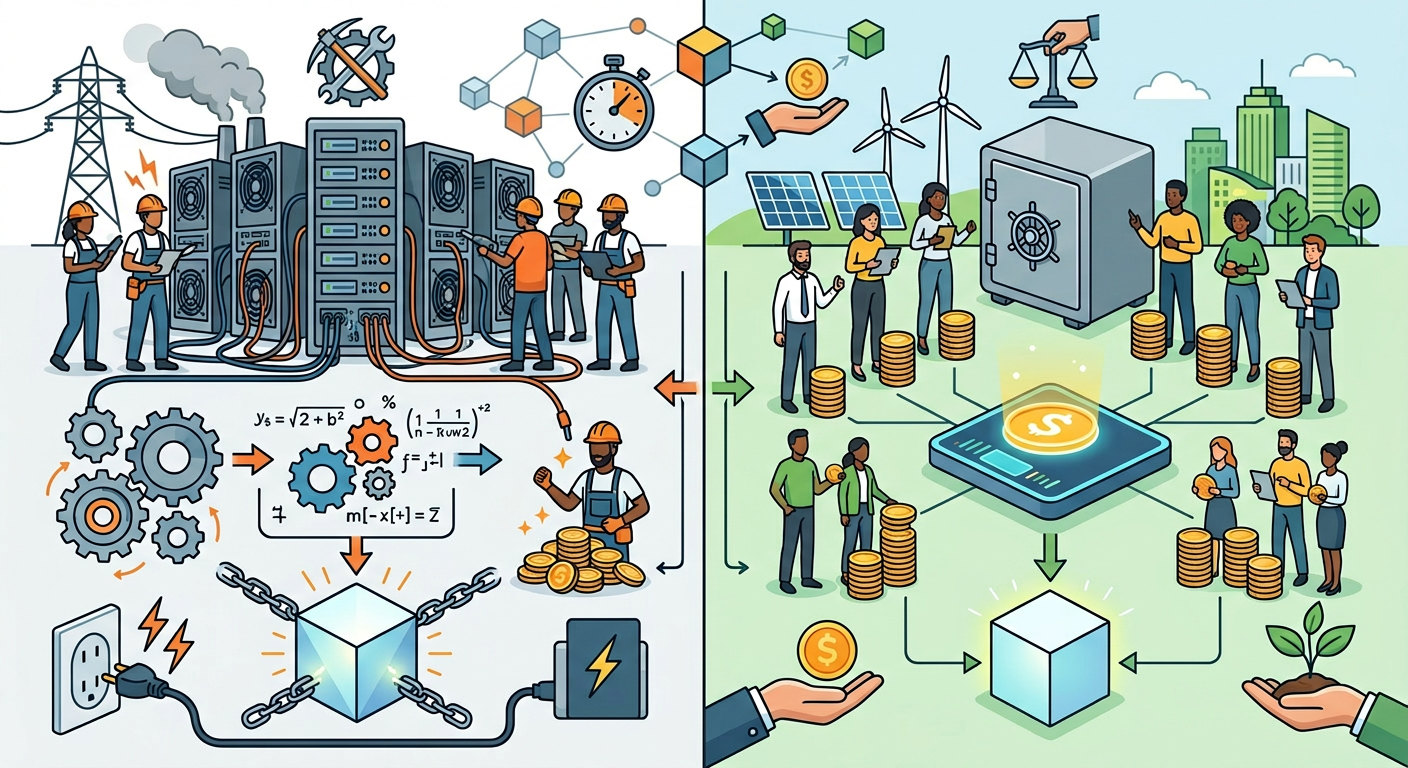
Proof of Work is a consensus mechanism that makes falsifying Bitcoin transaction history economically impossible. To rewrite one block, the attacker must re-do the computational work for that block and all subsequent ones - faster than the honest network produces new blocks. With a network hashrate of 745 EH/s in 2026, this requires equipment worth $15-20 billion and energy of hundreds of GW. POOL BTC analyzes the security and decentralization of the network.
In short: PoW protects Bitcoin through “invested work” - each block requires real calculations and electricity. No single participant can change history without spending as many resources as the rest of the network. This is what makes Bitcoin resistant to censorship and manipulation.
How exactly does Proof of Work work in Bitcoin?
The miner’s task is to find a number (nonce) that, when added to the block header, will start the SHA-256 hash with a specified number of zeros. This is called "difficulty". The more zeros required, the less likely it is to guess on the first try and the more calculations are needed.
Example (simplified): if the target is a hash less than 0x000000000000... (20 leading zeros), then the chance of any one hash to hit the target is approximately 1 in 16^20 = 10^24. A modern ASIC makes 234 * 10^12 attempts per second - and the average time a block is found by one device is millions of years.
Why doesn’t Bitcoin switch to Proof of Stake?
Ethereum switched to PoS in 2022, reducing energy consumption by 99.9%. The Bitcoin community consciously maintains PoW for several reasons:
| Criterion | Proof of Work | Proof of Stake |
|---|---|---|
| Security | Real energy (attack = $15+ billion) | Economic punishment (slashing) |
| Decentralization | Miners around the world | Concentrated in large holders |
| Energy consumption | ~150 TWh/year | Minimum |
| 51% attack | Requires physical hardware | Requires 51% stake |
| Proven track record | 15+ years without hacking | Less than 5 years of experience |
For Bitcoin PoW is not a disadvantage, but a key feature. Energy costs are a security price that can be physically verified.
How does the network difficulty adjust itself automatically?
Every 2016 blocks (about once every 2 weeks) Bitcoin automatically recalculates the difficulty. If the last 2016 blocks were found faster than 10 minutes on average, the difficulty increases. Slower - it decreases. This guarantees the stability of coin production regardless of how many miners are connected to the network.
Example: in May 2026, the difficulty reached 120 T (120 * 10^12). This means that the correct hash must be less than 2^256 / (120 * 10^12). Over the past 6 months, difficulty has increased by 35% along with hashrate.
How does PoW affect miner profitability?
An increase in difficulty directly reduces income per unit of hashrate. When the network hashrate doubles (without an increase in the BTC rate), the income of each miner is halved. That is why the choice of efficient equipment (J/TH) is critical: devices with high consumption are the first to leave the profitability zone as complexity increases. Calculate the break-even point for your equipment: POOL BTC calculator.
Frequently asked questions about Proof of Work
Can Bitcoin be hacked through a 51% attack?
Theoretically, yes, if you control more than half of the hashrate. Practically: the cost of renting 51% of 745 EH/s for 1 hour is about $10-15 million. And this only allows double spending, and not changing the protocol or other people’s coins. The last successful attack of 51% was on small altcoins, not on Bitcoin.
Why does Bitcoin waste so much electricity?
Consumption of ~150 TWh/year is the “cost of security”. For comparison: gold mining consumes ~120 TWh, global data centers for financial systems consume hundreds of TWh. More and more mining is powered by renewable sources - according to the Bitcoin Mining Council, the share of renewable energy sources exceeded 54% in 2026.
What will happen to PoW after all 21 million BTC are exhausted?
The last Bitcoin will be mined around 2140. After this, miners will only receive transaction fees. It is expected that by then the fees will be enough of an incentive to maintain the security of the network.
What is “merge mining”?
Merge mining allows you to simultaneously mine Bitcoin and its compatible altcoins (Namecoin, RSK, Liquid) without additional calculations. A hash solved for Bitcoin is simultaneously counted in other networks. This is an additional source of income without increasing electricity costs.
Bottom line: why Proof of Work remains a safety standard
Proof of Work is not an outdated mechanism, but an intentional choice of the Bitcoin community. Its key property is security based on the physical world: equipment, electricity, logistics. These real costs cannot be faked programmatically, unlike PoS cryptoeconomic penalties. In 15+ years of Bitcoin on PoW there has not been a single successful attack on the main chain. For a miner, this means stable rules of the game: difficulty is adjusted automatically, income depends only on hashrate and tariff. Calculate your share in the POOL BTC calculator.